 listicle
Commercial Door Hardware Supply Store: 2026 Guide
Table of Contents
- What to Expect from a Commercial Door Hardware Supply Store
- Commercial Door Hardware Components You Actually Need
- ADA Compliant Door Hardware Requirements for Commercial Buildings
- Commercial Door Closer Replacement Parts: What to Order and Why
- How to Measure Commercial Door Hardware Before You Order
- Applications by Building Type: Offices, Schools, Hospitals, and Retail
- Maintenance, Compliance, and Budgeting for Commercial Hardware Projects
- Frequently Asked Questions
Last Updated: September 2, 2026
What to Expect from a Commercial Door Hardware Supply Store
A commercial door hardware supply store is a specialized distributor that stocks and ships mechanical and electrical components for commercial doors, locks, closers, hinges, exit devices, frames, and seals. The right supplier helps you identify what you need before you order.
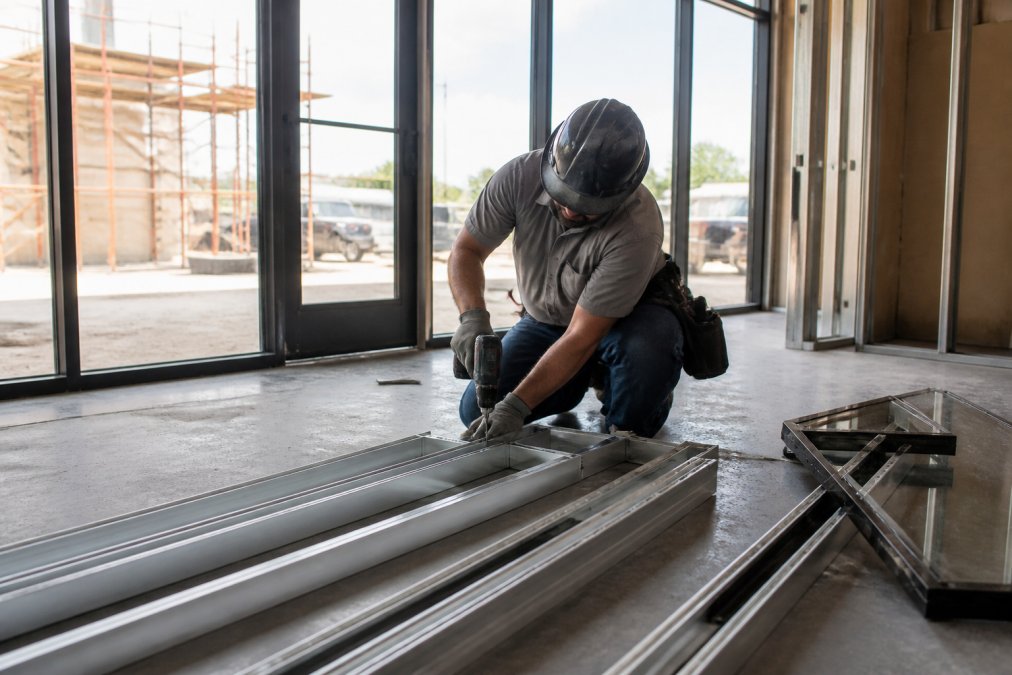
At S.O.S. Storefront Protection Shop, we supply contractors, property managers, and business owners nationwide with storefront doors, aluminum framing, hardware, and replacement parts. The most common frustration from new customers is that a previous distributor claimed to have stock, then took two weeks to ship it. That's a real problem when a storefront is boarded up and revenue is lost daily.
What separates a reliable supplier comes down to three things: verified inventory, product knowledge, and honest lead times. Before ordering anywhere, ask for confirmation of stock on hand, not just "available to order." Ask whether the supplier can advise on ANSI/BHMA grade requirements. Ask what happens if a part doesn't fit your setup.
According to the Door and Hardware Institute's industry resources, the commercial door hardware sector encompasses hundreds of product categories, which is why supplier expertise matters as much as inventory depth.
Commercial Door Hardware Components You Actually Need
Most procurement mistakes happen at the component selection stage. Ordering the wrong grade, backset, or hinge size costs time and money.
Locks, Levers, Knobs, and Deadbolts
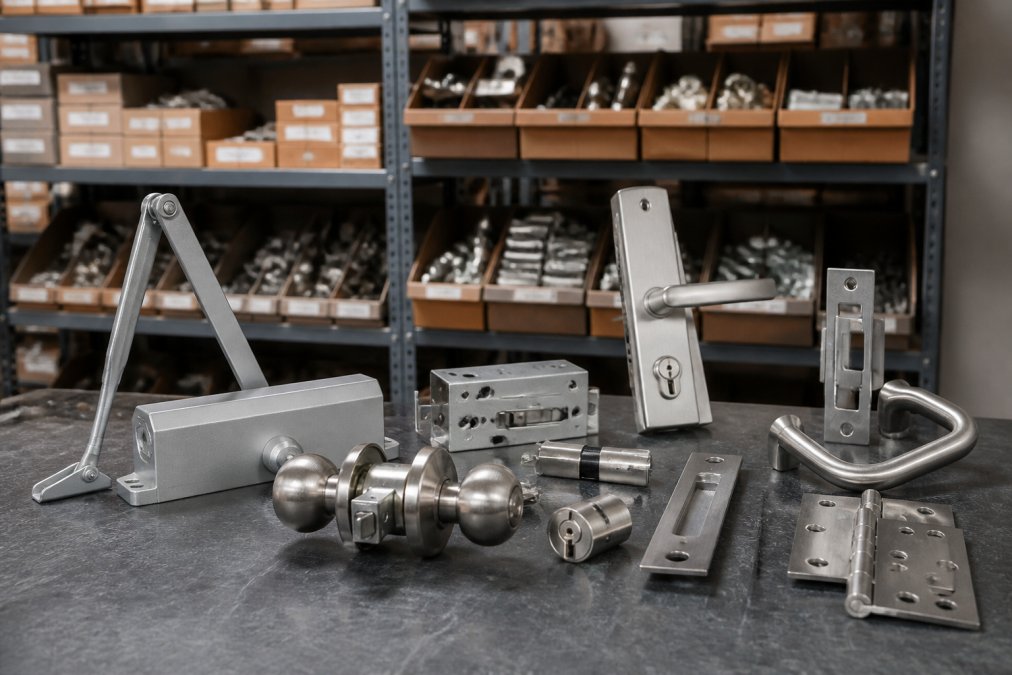
Lever locks and deadbolts are the foundation of any commercial door specification. For most commercial applications, levers are required over knobs, ADA compliance rules out knobs on accessible routes because they require tight grasping and twisting.
Commercial lever sets come in ANSI/BHMA Grade 1, Grade 2, and Grade 3. Grade 1 is standard for high-traffic commercial applications. Grade 2 works for light commercial and residential. Grade 3 is residential only. Specifying Grade 2 hardware on a school or hospital corridor door creates premature failure and potential liability.
Deadbolts add a secondary locking layer on perimeter doors. Electric strikes, such as the ASSA ABLOY HES 1006 Series, replace a standard strike plate and allow remote access control. Stainless steel hardware holds up better on high-traffic exterior doors exposed to weather.
Door Closers, Panic Bars, and Exit Devices
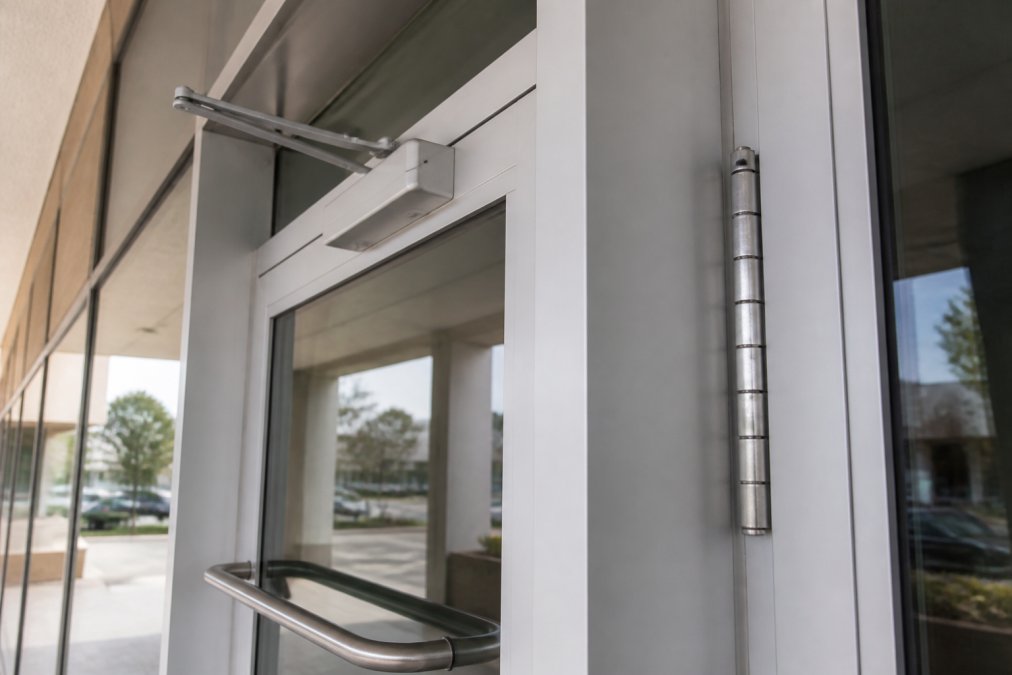
Door closers control the speed and force at which a door returns to its closed position. The LCN 4040XP Series is a surface-mounted, heavy-duty closer with adjustable spring power from size 1 through 6, designed for high-traffic commercial and institutional doors. It's non-handed, meaning it installs on either side without modification.
Exit devices and panic bars are required by fire code on most commercial egress doors. The Von Duprin 98/99 Series is a Grade 1 certified exit device available in rim, surface vertical rod, and mortise configurations. For secondary exits where unauthorized egress is a concern, the Detex ECL-230D alarmed exit control lock provides a 100-decibel alarm and deadlocking latch bolt, powered by a standard 9-volt battery.
Hinges, Thresholds, Seals, and Frames
Standard butt hinges work for most interior commercial doors, but heavy or high-traffic doors benefit from continuous hinges. The ABH A500 Series continuous hinge handles doors up to 600 lbs and runs the full door height, distributing load across the entire edge rather than concentrating stress at three hinge points.
Thresholds and door seals are often overlooked until there's a weather, smoke, or acoustic problem. Pemko perimeter gasketing, such as the 319_N Series, is BHMA certified, UL1784 smoke tested, and UL10C fire rated. Proper sealing is not optional on fire-rated assemblies, it's a code requirement.
Commercial door frames, both hollow metal and aluminum, must match the door type, wall thickness, and fire rating. Hollow metal doors and frames are standard for institutional applications. Aluminum storefront frames are the default for retail and commercial glass entrances.
ADA Compliant Door Hardware Requirements for Commercial Buildings
ADA compliant door hardware must be operable with one hand without tight grasping, pinching, or twisting of the wrist. This requirement, established under the ADA Standards for Accessible Design, eliminates round knobs and requires lever handles, loop pulls, or push-type hardware on all accessible doors.
The specific requirements include:
- Hardware height: Operable parts must be mounted between 15 inches and 48 inches above the finished floor
- Opening force: Interior hinged doors must require no more than 5 lbf to open
- Closing speed: Door closers must allow at least 5 seconds for the door to move from 90 degrees to 12 degrees from the latch
- Thresholds: Maximum threshold height of 0.5 inches for exterior sliding doors; 0.75 inches for other types, with beveled edges required above 0.25 inches
Many property managers assume their existing hardware is compliant without verifying it. A lever handle that requires excessive force or a closer adjusted too tight creates a compliance failure even if the hardware type is correct.
Commercial Door Closer Replacement Parts: What to Order and Why
Commercial door closer replacement parts are the most frequently ordered items from any commercial door hardware supply store, and also the most commonly ordered incorrectly. The most common mistake is ordering a replacement closer without checking whether the existing arm configuration, mounting bracket, and door prep are compatible.
Before ordering replacement parts, identify:
- The closer brand and series, stamped on the closer body
- The arm type, regular arm, parallel arm, or top jamb mount
- The door hand, left-hand or right-hand swing
- The door size and weight, determines the required spring power
- The existing door prep, surface-mounted or concealed closer pocket
Fluid leaks are the most common sign that a closer needs replacement. Once hydraulic fluid escapes, no adjustment restores proper function. Arm replacement alone is sometimes sufficient when the cylinder is intact.
How to Measure Commercial Door Hardware Before You Order
Getting measurements wrong before ordering commercial door hardware is expensive. Most returns trace back to incorrect field measurements.
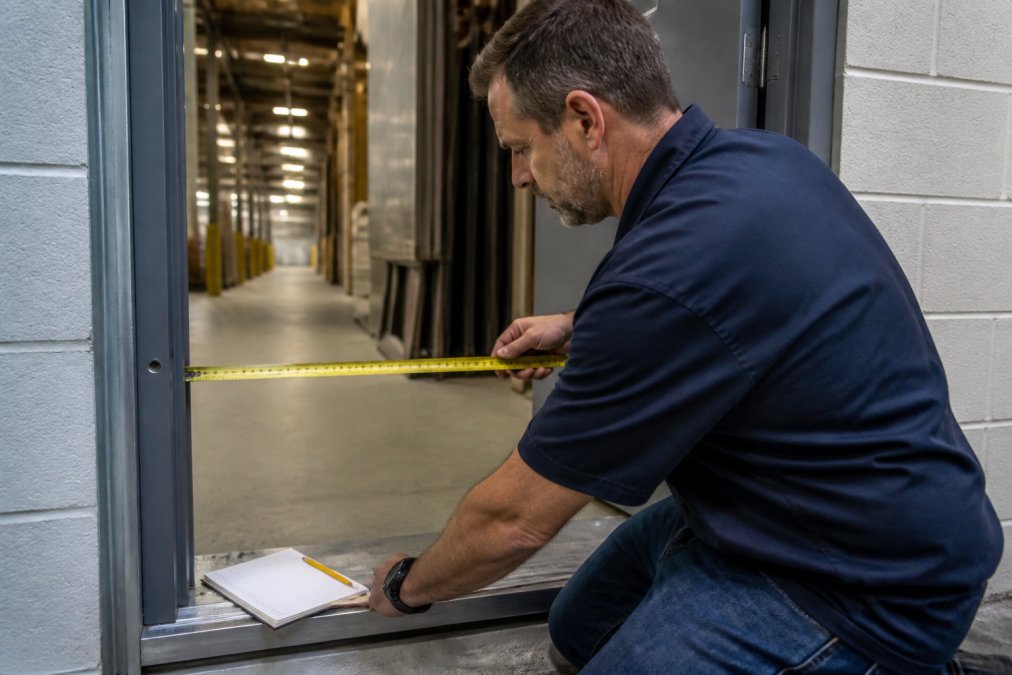
Here's what to measure:
Door size: Measure the door slab height and width, not the frame opening. Standard commercial door sizes are 3'0" x 7'0" and 3'0" x 8'0", but field-installed doors frequently deviate.
Door thickness: Measure the door slab at the edge. Commercial hollow metal doors are typically 1-3/4" thick. Closer arms, hinges, and locksets all have thickness tolerances.
Backset: For locksets and deadbolts, measure from the door edge to the center of the bore hole. Standard commercial backsets are 2-3/4" or 3-3/4". An incorrect backset means the latch won't align with the strike.
Hinge spacing: Measure existing hinge locations from the top of the door. Replacement hinges must match existing prep locations unless you're willing to fill and re-drill.
Frame rabbet: For strike plates and electric strikes, measure the frame rabbet depth. A strike specified for a standard frame won't seat correctly in a deep-rabbet frame.
| Measurement | What to Measure | Common Sizes |
|---|---|---|
| Door height | Slab height, not frame opening | 7'0", 8'0" |
| Door width | Slab width, not frame opening | 3'0", 3'6", 4'0" |
| Door thickness | Edge of slab | 1-3/4", 1-3/8" |
| Backset | Door edge to bore center | 2-3/4", 3-3/4" |
| Hinge size | Leaf height x leaf width | 4.5" x 4.5", 5" x 4.5" |
| Frame rabbet | Strike recess depth | 5/8", 7/8" |
Applications by Building Type: Offices, Schools, Hospitals, and Retail
The right hardware specification changes depending on building type, occupancy load, and code requirements.
Office buildings typically require Grade 1 lever locksets on suite entry doors, door closers on fire-rated corridor doors, and electric strikes on access-controlled entries.
Schools are among the most demanding environments for commercial door hardware. High traffic and deliberate abuse push hardware to its limits. Grade 1 closers like the LCN 4040XP are standard. Classroom security locksets, which allow locking from inside without a key in the corridor, are now common.
Hospitals and healthcare facilities add infection control considerations. Lever handles are preferred where hands-free operation is possible. Automatic door operators are common on accessible routes. Closers must be adjusted for compliant opening force and closing speed.
Retail storefronts rely heavily on aluminum framing, commercial glass doors, and heavy-duty closers for high-volume entrances. A busy retail entrance cycles thousands of times per day. Panic hardware on rear exit doors is typically required by local fire code.
Maintenance, Compliance, and Budgeting for Commercial Hardware Projects
Routine Maintenance That Extends Hardware Life
Commercial door hardware is built for durability but requires maintenance. A structured program extends hardware life and reduces emergency replacements.
The most important maintenance tasks:
- Door closers: Check and adjust sweep speed, latch speed, and backcheck annually. Inspect for fluid leaks. Lubricate arm pivot points with light machine oil.
- Hinges: Check for loose screws and worn pivot pins twice per year. Continuous hinges should be inspected for bent leaves and lubricated along the full length.
- Locks and levers: Clean and lubricate the latch mechanism annually. Check that the latch aligns cleanly with the strike.
- Exit devices: Test the touchbar operation and latch retraction monthly. Inspect mounting screws for loosening.
- Seals and thresholds: Inspect annually for compression set, tearing, or gaps. Replace EPDM or neoprene inserts before they fail.
Fire Codes, ANSI/BHMA Grades, and What They Mean for Procurement
ANSI/BHMA grading is the standard framework for commercial door hardware performance in the United States. Grade 1 hardware must pass the most rigorous cycle testing, typically 250,000 cycles for closers and locksets. Grade 2 is rated for light commercial use. Grade 3 covers residential applications only.
Fire codes, enforced at the state and local level but grounded in NFPA 80 standards, dictate which hardware components are permitted on fire-rated door assemblies. Key requirements include:
- Positive latching: Fire doors must latch positively when closed. Magnetic hold-opens must release on fire alarm activation.
- Closer requirements: Fire-rated doors in corridors must have closers rated for the door's fire label.
- Coordinator requirements: Pairs of fire doors with both active and inactive leaves require a coordinator to ensure the inactive leaf closes first.
- Labeled hardware: Hardware on fire-rated assemblies must carry the appropriate UL label. Substituting unlabeled hardware voids the door assembly's fire rating.
The NFPA 80 Standard for Fire Doors and Other Opening Protectives is the primary reference for fire door assembly requirements. Annual inspection of fire-rated door assemblies is required, and non-compliant hardware must be replaced.
Budgeting Considerations Without Guessing on Price
Budgeting for commercial door hardware projects requires specifying by grade and function first, then getting a complete hardware schedule that lists every component for every opening. This prevents forgetting coordinators, strikes, seals, and mounting hardware.
Account for installation labor, concealed hardware, continuous hinges, overhead holders, and electric strikes take longer to install than surface-mounted equivalents. Request a quote rather than estimating from list prices, as pricing depends on quantity, lead time, and availability. Contact S.O.S. Storefront Protection Shop directly for current pricing on specific components. We work with contractors and property managers at any project scale, from single-door repairs to full building specifications.
For projects requiring fast turnaround, confirm stock availability before committing to a schedule. Many distributors list products as "available" when they're actually on backorder.
Sourcing commercial door hardware under time pressure requires a supplier that combines verified inventory with product expertise. S.O.S. Storefront Protection Shop supplies commercial doors, aluminum framing, hardware, closers, hinges, and replacement parts nationwide, with the product knowledge to help you specify correctly the first time. Whether you're managing a single replacement or a full building specification, reach out to S.O.S. Storefront Protection Shop to confirm stock and get your project moving.
Frequently Asked Questions
What is the difference between residential and commercial grade door hardware?
Commercial door hardware is built to ANSI/BHMA Grade 1 or Grade 2 standards, meaning it withstands far more daily cycles than residential hardware. A Grade 1 commercial lock is tested to 250,000 cycles, while most residential hardware is rated for 250,000 or fewer under lighter loads. Commercial hardware also uses heavier gauge metals, larger fasteners, and more durable finishes designed for high-traffic environments like offices, schools, and hospitals. Residential hardware will fail quickly in those settings.
How do I ensure the door hardware I buy meets ADA compliance standards?
ADA-compliant door hardware must meet specific requirements under the Americans with Disabilities Act. Lever handles are required instead of round knobs because they can be operated with a closed fist. Hardware must require no more than 5 pounds of force to operate, and operable parts must be mounted between 15 inches and 48 inches above the finished floor. When ordering from a commercial door hardware supply store, ask specifically for ADA-compliant levers, pulls, and closers, and confirm the closer is set to the correct closing force.
Can I get same-day or fast shipping on commercial door hardware parts?
Many commercial door hardware suppliers, including S.O.S. Storefront Protection Shop, stock commonly needed components for fast turnaround. Availability depends on the specific part, quantity, and shipping destination. The best approach is to confirm stock before ordering, especially for replacement parts on urgent repairs. Suppliers with a strong stocking inventory and nationwide shipping capability are the most reliable option when a storefront is boarded up or a door is out of service.
How do I identify the correct replacement part for a commercial storefront door?
Start by locating the manufacturer's name and model number stamped or labeled directly on the hardware, usually on the body of the closer, the rail of an exit device, or the backplate of a lock. If the label is worn, note the door type (hollow metal, aluminum, wood), the door width and weight, and the handing (which side the hinges are on). A knowledgeable commercial door hardware supply store can cross-reference these details to match the correct replacement part, even when the original model has been discontinued.
This article was written using GrandRanker